Trust & Security
Control is part of execution.
AI that can take action inside enterprise systems needs a different security model from AI that only generates an answer.
The Globalnetrix platform puts identity, permissions, workflow policy, human approval and auditability into the execution path itself.
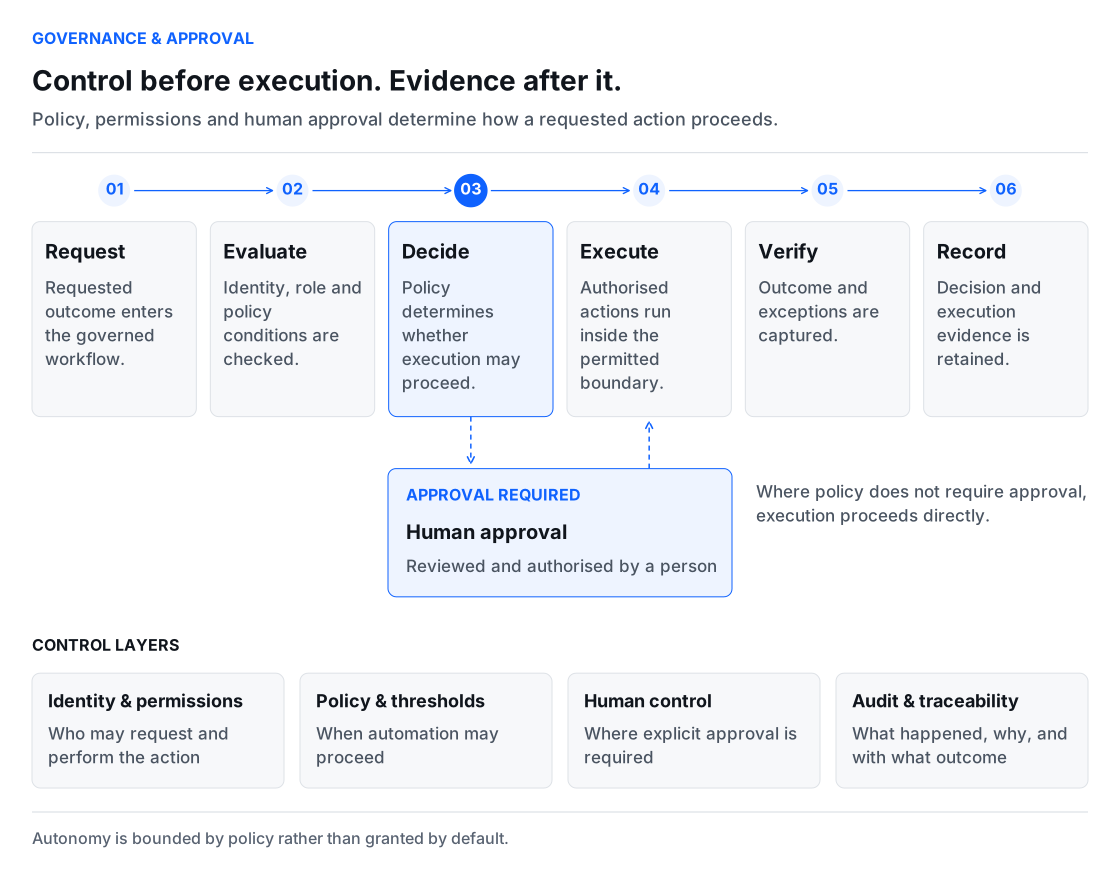
Security is enforced before an action runs.
A request does not become a system action simply because an AI model understood it.
The platform evaluates the requester’s access, the workflow policy and any approval requirements before execution. The workflow then stays inside the permissions and systems assigned to that process.
Role-based access — Actions operate within the permissions assigned to the requester and the relevant system role.
Segregation of duties — Sensitive operations can be separated across roles instead of concentrated in one account.
Approval gates — Workflows can require explicit human authorisation before a controlled action proceeds.
Execution boundaries — Automated actions stay within configured permissions, policies and approved workflow paths.
Tenant and credential boundaries
Enterprise integrations bring together systems that were not originally designed to share one control plane. Those connections need their own boundaries.
Tenant isolation — Customer data, configuration and credentials are separated by tenant.
Credential handling — Integration credentials and tokens are protected in transit and at rest and are managed through the integration layer rather than embedded into workflow content.
Per-tenant policy — Connectors, workflows and access policies are configured independently for each tenant.
Controlled system access — Workflows call connected systems through defined integrations rather than exposing unrestricted system access to the AI layer.
Human control stays where policy requires it.
Automation is not the same as unrestricted autonomy.
A workflow can stop at an approval point before a sensitive or high-impact action executes. The reviewer sees the requested action in context and authorises the workflow to continue.
That makes human involvement a policy decision inside the execution model rather than an informal step outside it.
Traceability from request to outcome
Operational review requires more than a conversation transcript.
The Globalnetrix platform records the execution path around the request: workflow decisions, integration calls, approval events and resulting outcomes.
This provides a traceable record of what was requested, what the workflow did and what the connected systems returned.
Request context — What outcome was requested and which workflow handled it.
Decision record — Which policy and approval path applied.
System activity — Which connected services were called as part of the workflow.
Outcome — What completed, what failed and what was returned to the requester.
AI output does not bypass the control plane.
The language model contributes understanding and context. It does not replace identity, policy or workflow controls.
Requests still move through the same access checks, approval requirements, workflow definitions and integration boundaries before an action reaches a connected system.
This separation is central to using AI in workflows where the consequence of a wrong action matters.
Deployment choices for different control requirements
Managed platform — Centrally operated service delivery with platform maintenance handled for the customer.
Dedicated environment — Greater infrastructure isolation for organisations with stricter governance requirements.
Private deployment — Customer-controlled infrastructure for environments that require it.
The appropriate deployment model is determined during technical and security review.
Compliance posture
Security and compliance requirements differ by industry, jurisdiction and deployment model.
The Globalnetrix platform structures identity, access control, auditability, tenant separation and workflow governance so those controls can be assessed against the requirements relevant to an organisation.
Framework mapping, evidence requirements and any applicable certification or attestation status are handled explicitly during a qualified security review. Control alignment is not presented as formal certification unless that status has been independently attained.
Responsible AI in an execution environment
The practical question is not only whether a model can produce the right answer. It is what happens when the answer is incomplete, ambiguous or wrong.
The execution model reduces that risk by separating model interpretation from authorisation and system access:
Clarify uncertainty — Incomplete requests can be returned for clarification rather than executed on an assumption.
Apply policy — Permission and workflow rules determine what may proceed.
Keep people in the path — Approval gates remain available for sensitive actions.
Preserve evidence — The request, decisions, system activity and outcome remain traceable.
Security information for enterprise review
For a qualified technical or security evaluation, we can provide the appropriate architecture, control and deployment information for the proposed environment.
Implementation-level details that are not appropriate for a public website are handled through the review process.